Authentication
Every webhook EquiDeFi sends is signed with a secret that only you and EquiDeFi know. Checking that signature is how your endpoint knows a request really came from EquiDeFi and wasn't changed on the way. Webhook requests carry no API key, username or password: the signature is the authentication.
This page covers the whole flow: getting your signing secret, what each request contains, how the signature is built, and how to verify it.
How it works
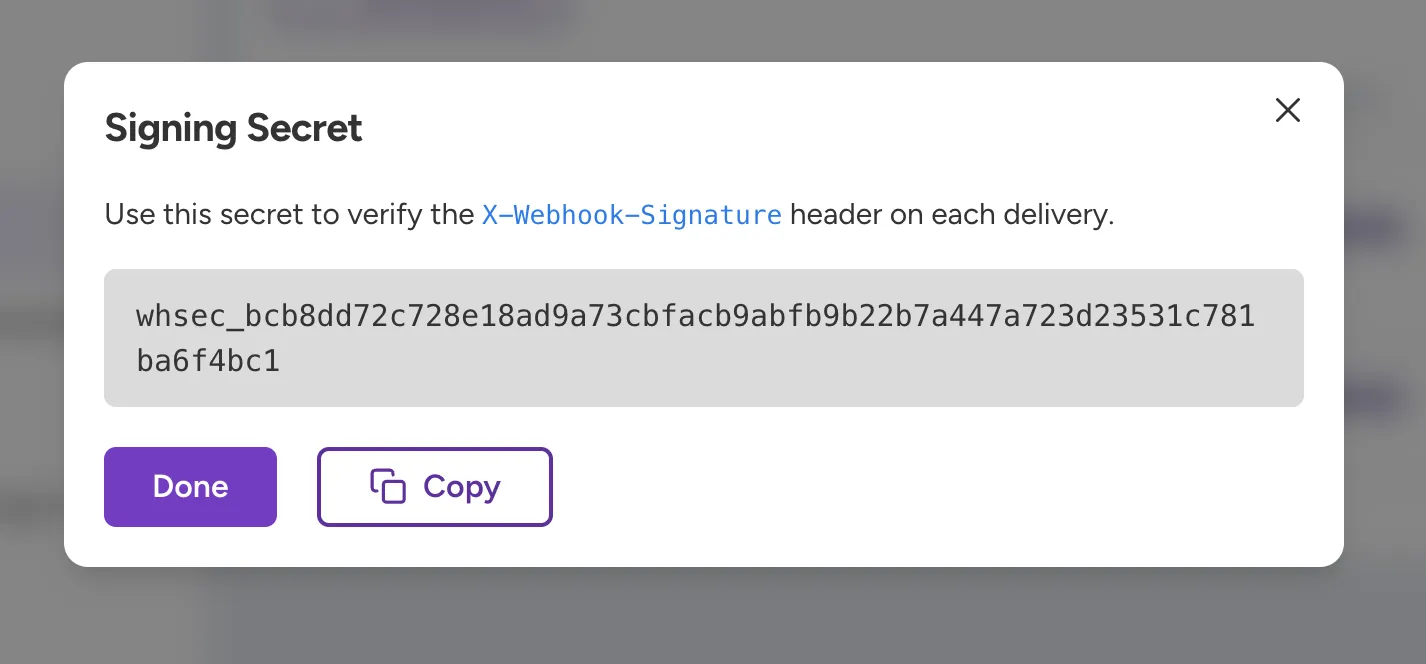
- When you create a webhook subscription, EquiDeFi generates a signing secret for it. It starts with whsec_.
- For every delivery, EquiDeFi computes an HMAC-SHA256 of the timestamp and the raw request body, using that secret as the key.
- The result is sent in the X-Webhook-Signature header.
- Your endpoint computes the same HMAC with its copy of the secret. If the two match and the timestamp is recent, the request is genuine.
Step 1: Get your signing secret
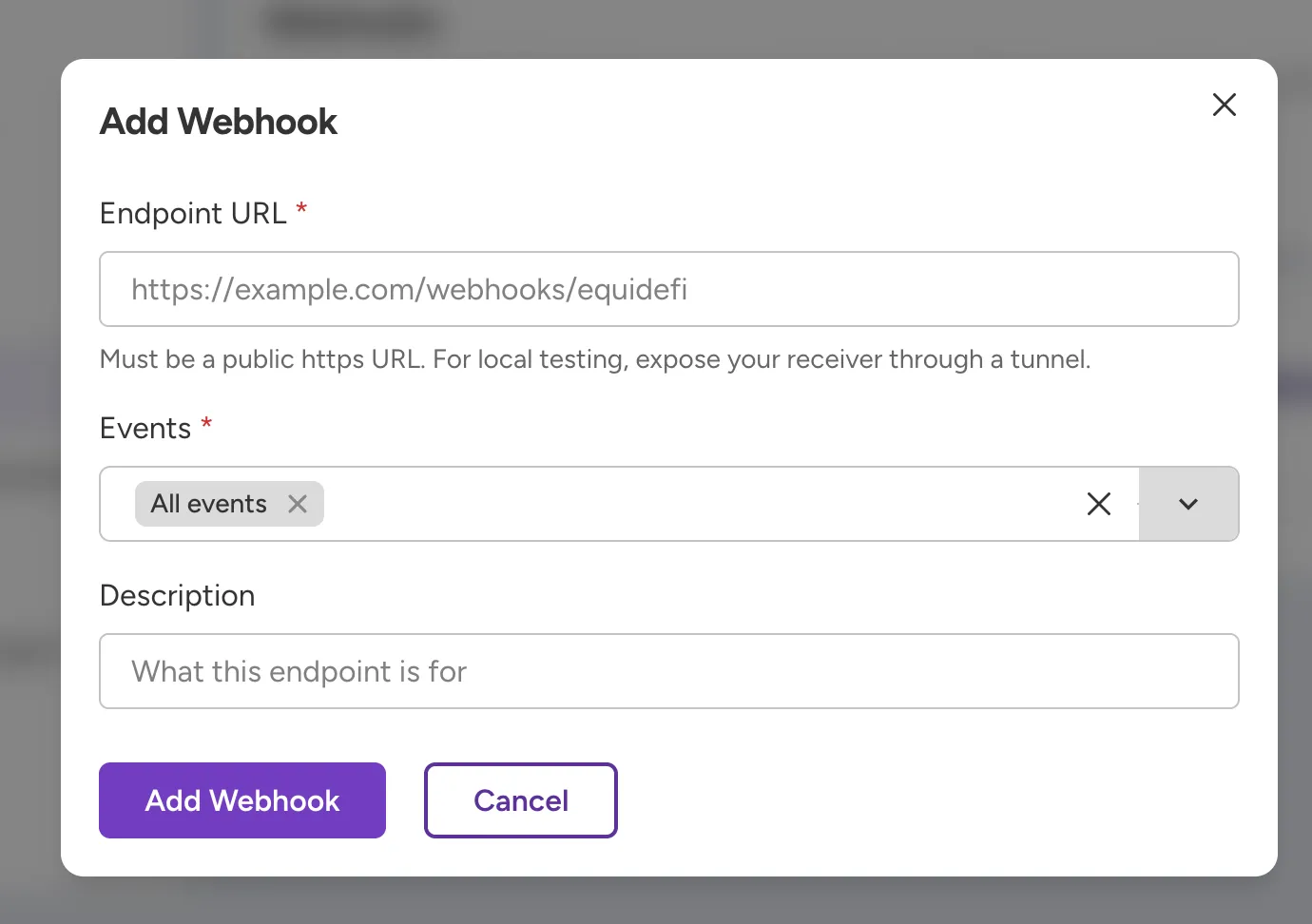
Go to Offering Settings → Webhooks and click Add Webhook. Getting StartedGetting Started walks through this screen in detail.
As soon as the subscription is created, its signing secret is shown. Copy it and store it with your other server secrets, for example in an EQUIDEFI_WEBHOOK_SECRET environment variable.
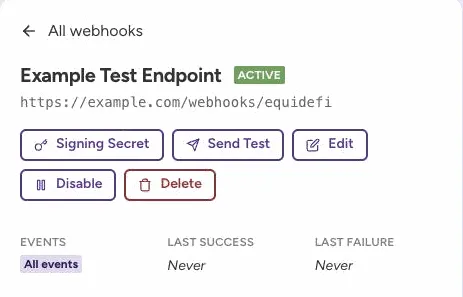
You can see the secret again at any time with the Signing Secret button on the subscription's page.
Each subscription has its own secret. If you have more than one subscription (one per environment or one per endpoint, for example), make sure each endpoint verifies with the secret of the subscription that sends to it.
Use the whole secret as the HMAC key, including the whsec_ prefix. Treat it like a password: keep it out of source control, client-side code and logs.
Step 2: Understand the request
Every delivery is an HTTPS POST with a JSON body and these headers:
Header | Example | What it's for |
|---|---|---|
Content-Type | application/json | The body is JSON. |
User-Agent | EquiDeFi-Webhooks/1 | Identifies EquiDeFi's webhook sender. |
X-Webhook-Id | 8b1f6c2e-4d3a-4f5b-9c7e-2a1d0e9f8b7c | The event's unique ID. It stays the same on every retry, so use it to skip duplicates. |
X-Webhook-Event | KYC.APPROVED | The event name. See Events. |
X-Webhook-Timestamp | 1763308800 | When this attempt was signed, in Unix seconds. |
X-Webhook-Signature | t=1763308800,v1=879b94ee… | The timestamp and signature you verify. |
A full request looks like this:
POST /webhooks/equidefi HTTP/1.1
Host: example.com
Content-Type: application/json
User-Agent: EquiDeFi-Webhooks/1
X-Webhook-Id: 8b1f6c2e-4d3a-4f5b-9c7e-2a1d0e9f8b7c
X-Webhook-Event: KYC.APPROVED
X-Webhook-Timestamp: 1763308800
X-Webhook-Signature: t=1763308800,v1=879b94ee58f202a2e87084069d1d53eebe1f60f1ac6ca400588d1b6488310675

{"data":{"id":"8b1f6c2e-4d3a-4f5b-9c7e-2a1d0e9f8b7c","type":"event", ...}}
Step 3: Understand the signature
The X-Webhook-Signature header is a comma-separated list of key=value parts:
- t: the Unix timestamp (seconds) when the request was signed. It matches X-Webhook-Timestamp.
- v1: the signature, as lowercase hex.
The signature is computed like this:
signed_payload = "{t}.{raw request body}"
v1 = hex( HMAC-SHA256( key = signing secret, message = signed_payload ) )
The timestamp is part of what's signed, so nobody can take an old request and change its timestamp to make it look new.
The header can contain more than one v1 value, for example t=1763308800,v1=abc…,v1=def…. Accept the request if any one of them matches. That keeps your integration working through a future secret rotation.
Step 4: Verify every request
For each incoming request:
- Read the raw body. Use the exact bytes you received, before any JSON parsing. A parsed and re-serialized body will almost never match the signature.
- Parse X-Webhook-Signature. Split on ,, then split each part on the first =. Keep the t value and every v1 value.
- Check the timestamp. Reject the request if t is more than 5 minutes (300 seconds) away from your server's current time, in either direction.
- Compute the expected signature. HMAC-SHA256 of {t}.{raw body} with your signing secret, as hex.
- Compare in constant time. Use your language's constant-time comparison (timingSafeEqual, hmac.compare_digest, hash_equals), never ==. Accept if any v1 matches.
- Respond. If verification fails, return 400 and stop. If it passes, process the event and return a 2xx.
Copy one of these into your webhook endpoint. Each one includes a commented example for a common framework:
const crypto = require("node:crypto");

const TOLERANCE_SECONDS = 300;

/**
 * Verifies an EquiDeFi webhook. `rawBody` must be the request body exactly as
 * received (a Buffer or string); a re-serialized JSON object will not match.
 */
function verifyEquidefiWebhook(rawBody, signatureHeader, secret, now = Date.now()) {
  if (!signatureHeader) return false;

  // X-Webhook-Signature: t=<unix seconds>,v1=<hex>[,v1=<hex>] (two v1 values during secret rotation)
  let timestamp;
  const signatures = [];
  for (const part of signatureHeader.split(",")) {
    const separator = part.indexOf("=");
    if (separator === -1) continue;
    const key = part.slice(0, separator).trim();
    const value = part.slice(separator + 1).trim();
    if (key === "t" && /^\d+$/.test(value)) timestamp = Number(value);
    else if (key === "v1" && value) signatures.push(value);
  }
  if (timestamp === undefined || signatures.length === 0) return false;

  // Reject stale or future-dated deliveries to limit replays.
  if (Math.abs(Math.floor(now / 1000) - timestamp) > TOLERANCE_SECONDS) return false;

  const expected = crypto.createHmac("sha256", secret).update(`${timestamp}.`).update(rawBody).digest("hex");

  return signatures.some(
    (signature) =>
      signature.length === expected.length &&
      crypto.timingSafeEqual(Buffer.from(signature), Buffer.from(expected)),
  );
}

module.exports = { verifyEquidefiWebhook };

// Express: read the body raw on this route, then parse it yourself after verifying.
//
// app.post("/webhooks/equidefi", express.raw({ type: "application/json" }), (req, res) => {
//   if (!verifyEquidefiWebhook(req.body, req.get("X-Webhook-Signature"), process.env.EQUIDEFI_WEBHOOK_SECRET)) {
//     return res.sendStatus(400);
//   }
//   const event = JSON.parse(req.body.toString("utf8"));
//   // X-Webhook-Id is the same on every retry of an event; use it to skip duplicates.
//   res.sendStatus(200);
// });
Step 5: Protect against replays and duplicates
- Replays. The 5-minute timestamp check stops someone from capturing a genuine request and sending it to you again later. Keep your server clock in sync (NTP), or genuine requests may be rejected.
- Duplicates. If your endpoint fails or times out, EquiDeFi sends the same event again. Every retry is signed again with a new timestamp, but X-Webhook-Id stays the same. Record the IDs you've processed and skip any you've already seen.
Step 6: Respond
- Return any 2xx to tell EquiDeFi the delivery succeeded. Anything else, including redirects, counts as a failure.
- Respond within 15 seconds. If you have slow work to do, store the event, return 200, and process it afterwards.
- Return 400 when verification fails, so the failure shows in your delivery log.
See Retry BehaviorRetry Behavior for timeouts, the retry schedule and the delivery log.
Test your integration
Use Send Test
Open your subscription and click Send Test. To try a different URL before you save it, click Edit and use Send Test in the dialog. EquiDeFi sends a signed TEST.SENT event with the subscription's real signing secret and shows you what your endpoint returned. A test contains no investor data and doesn't appear in the delivery log.
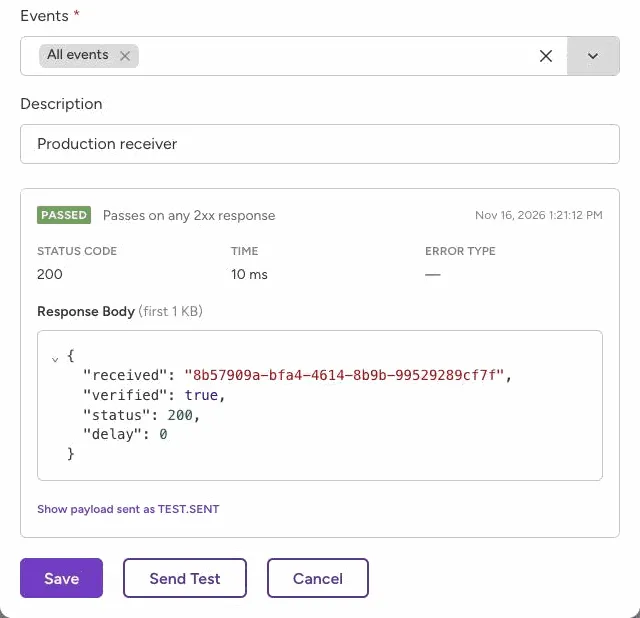
A 2xx means your endpoint accepted the signed request. A 400 here means your verification is rejecting a genuine request; see Troubleshooting below.
Check your code against a known example
Use these values in a unit test. Your code should compute exactly this signature:
Input | Value |
|---|---|
Secret | whsec_7f9a1c3e5b2d4f6a8c0e1b3d5f7a9c2e4b6d8f0a1c3e5b7d9f2a4c6e8b0d1f3a |
Timestamp (t) | 1763308800 |
Raw body | {"data":{"id":"8b1f6c2e-4d3a-4f5b-9c7e-2a1d0e9f8b7c","type":"event","attributes":{"event":"TEST","action":"SENT"}}} |
Expected v1 | 879b94ee58f202a2e87084069d1d53eebe1f60f1ac6ca400588d1b6488310675 |
Or check it from a terminal:
printf '%s' '1763308800.{"data":{"id":"8b1f6c2e-4d3a-4f5b-9c7e-2a1d0e9f8b7c","type":"event","attributes":{"event":"TEST","action":"SENT"}}}' \
  | openssl dgst -sha256 -hmac 'whsec_7f9a1c3e5b2d4f6a8c0e1b3d5f7a9c2e4b6d8f0a1c3e5b7d9f2a4c6e8b0d1f3a'
This timestamp is in the past, so pass a matching "now" into your function when you run this test. The examples above all accept one: 1763308800000 in milliseconds for JavaScript and TypeScript, 1763308800 in seconds for Python, Ruby and PHP.
Troubleshooting
If your endpoint rejects requests that came from EquiDeFi, check these first:
Symptom | Likely cause | Fix |
|---|---|---|
Signature never matches | Your framework parsed the JSON before you verified it. | Read the raw body on your webhook route: express.raw(), request.get_data(), request.raw_post or php://input. |
Signature never matches | Wrong secret. | Copy the secret from this subscription's Signing Secret button, including whsec_, with no extra spaces or line breaks. |
Signature never matches | You signed only the body. | The signed message is {t}.{body}, with a dot between them. |
Works locally, fails in production | A proxy or middleware changes the body. | Make sure nothing re-encodes, pretty-prints or decompresses the body before your check. |
Some requests fail the timestamp check | Your server clock is off. | Sync your clock with NTP. The allowed window is 5 minutes. |
Send Test shows a 3xx | Your URL redirects. | Use the final URL. EquiDeFi doesn't follow redirects. |
Related
- Getting StartedGetting Started: create and manage webhook subscriptions.
- Best PracticesBest Practices: general advice for webhook consumers.
- Retry BehaviorRetry Behavior: timeouts, retries and the delivery log.
- Events: every event and its payload.